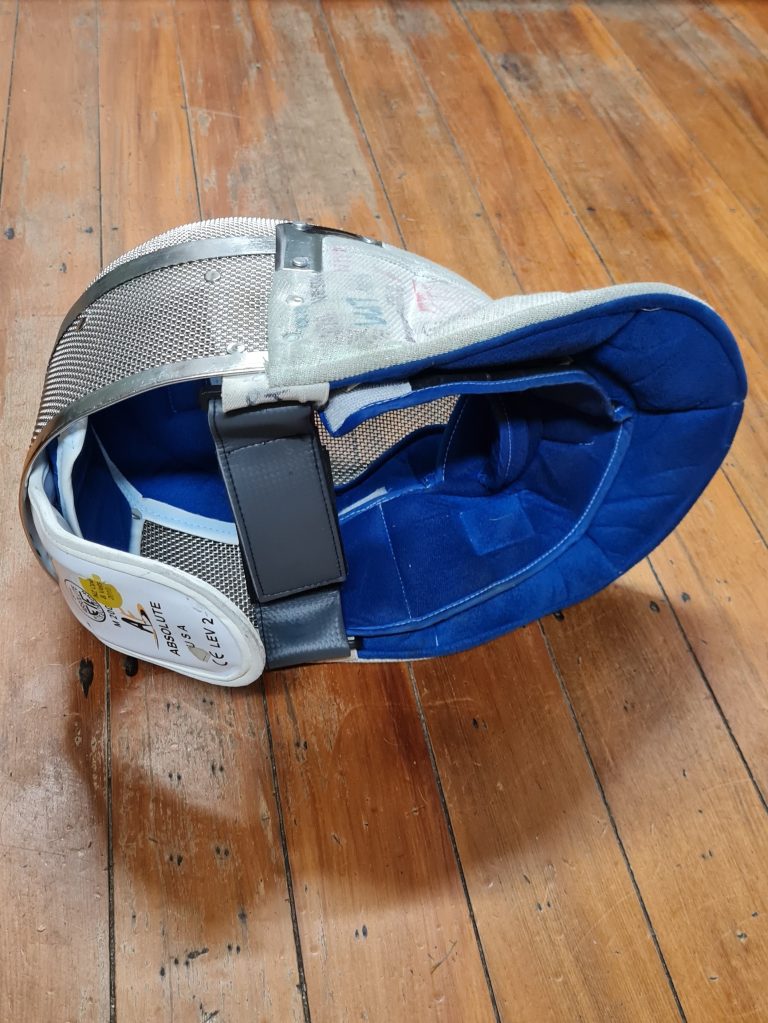
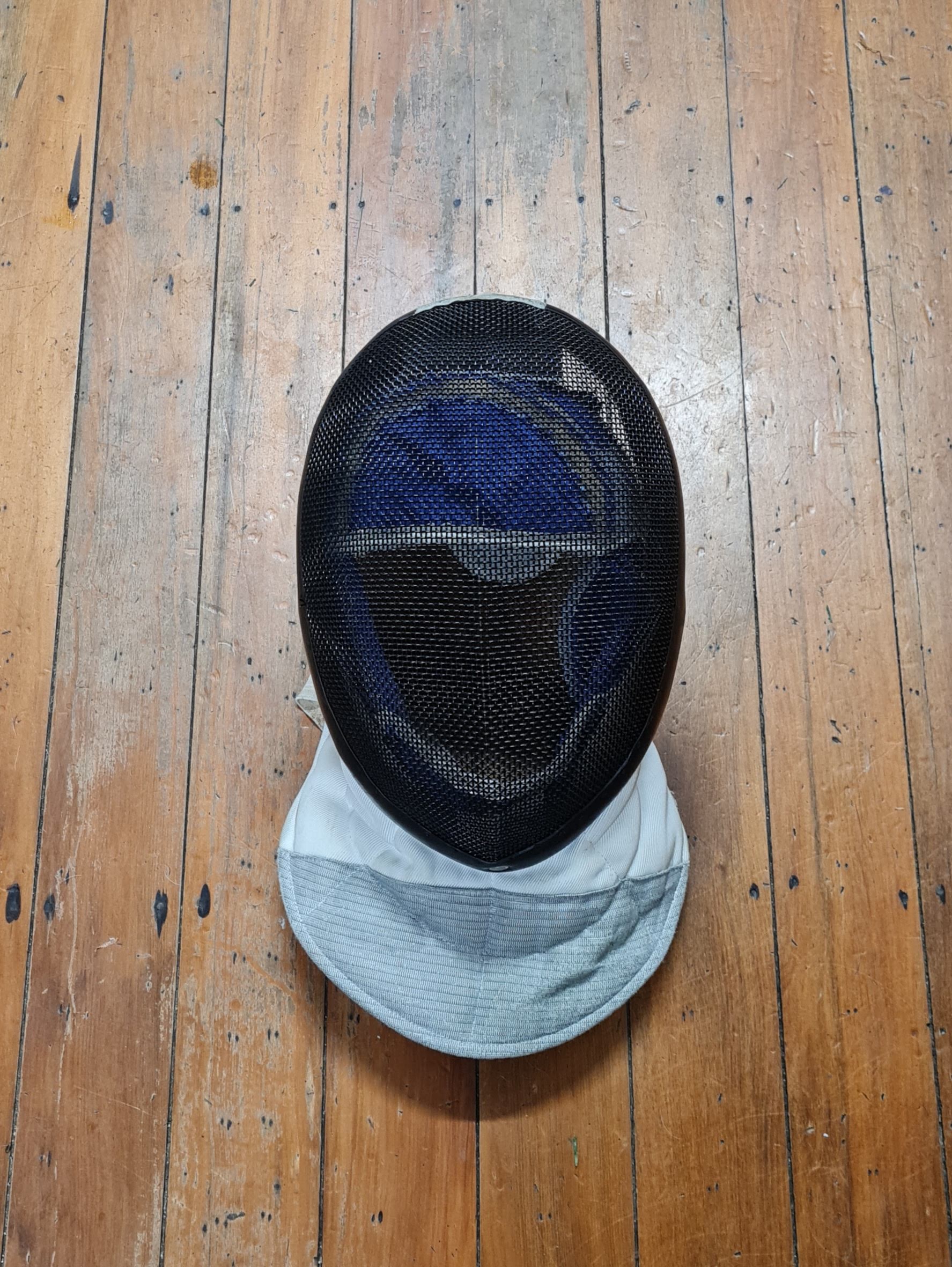
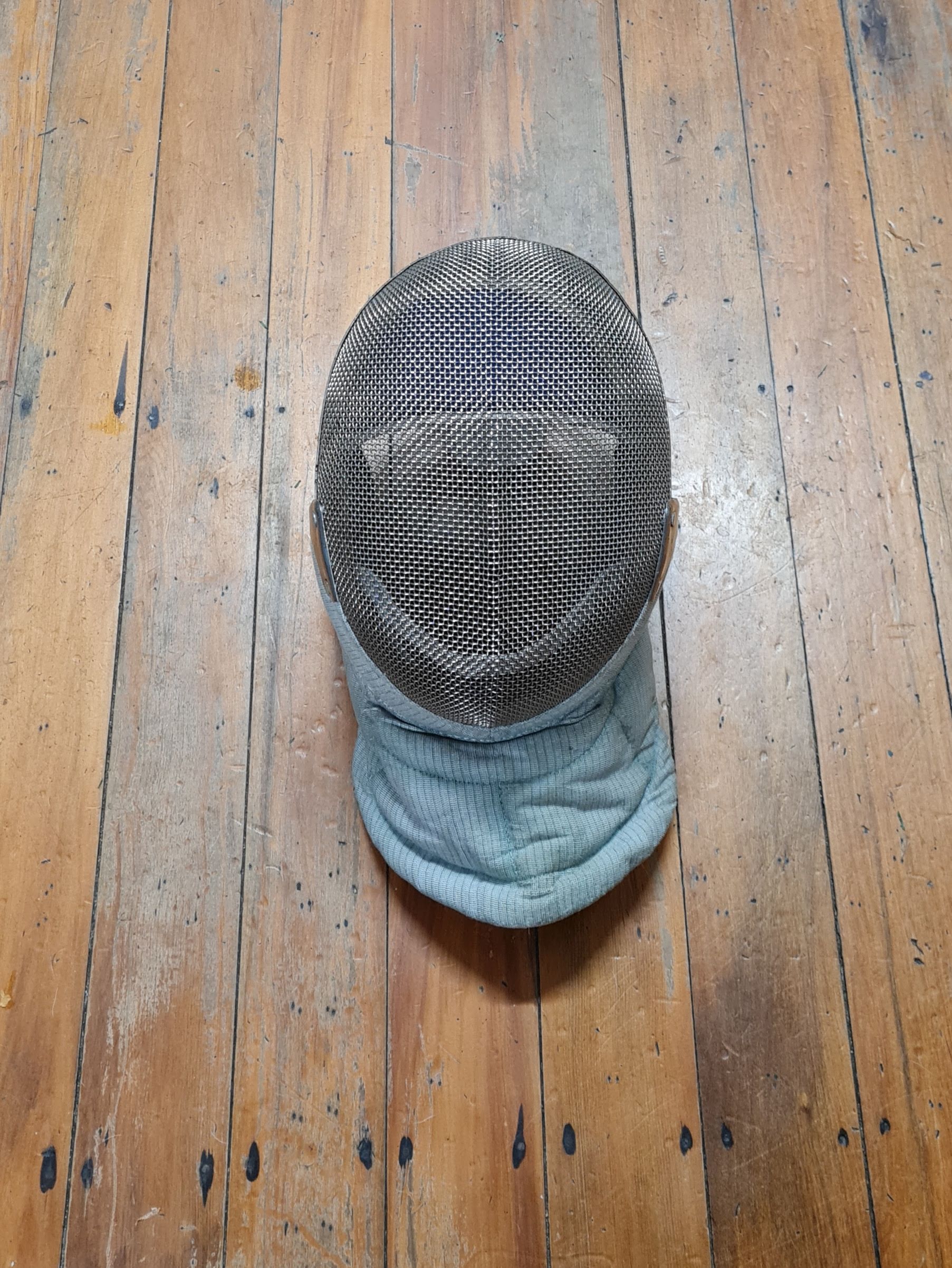
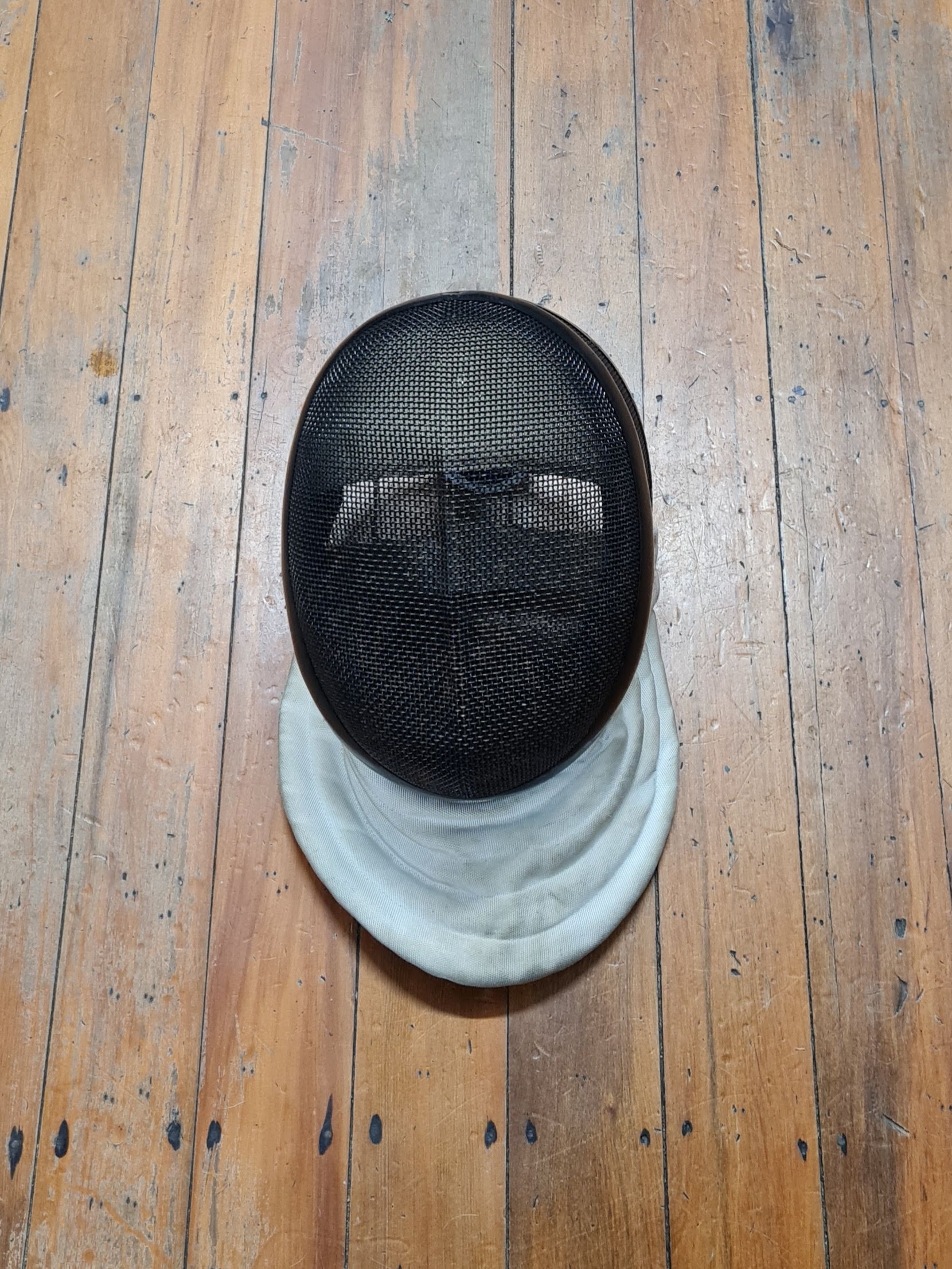
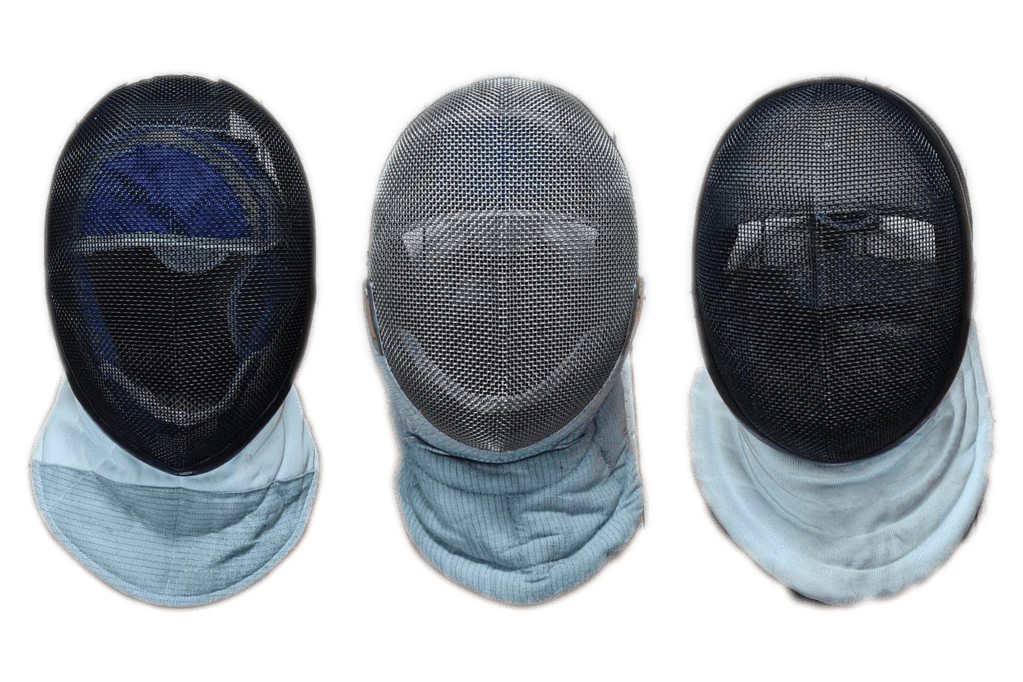
For Masks with normal tongues, you will be required to use a strap that doubles over like in the photo. This is applicable in all competitions and is encouraged at a club level.
An advantage that this system has is the adjustability coupled with addressing some safety concerns. Traditional elastic is subject to stretching an no longer functioning as intended. This system is easier to replace frayed elastic from excessive use.
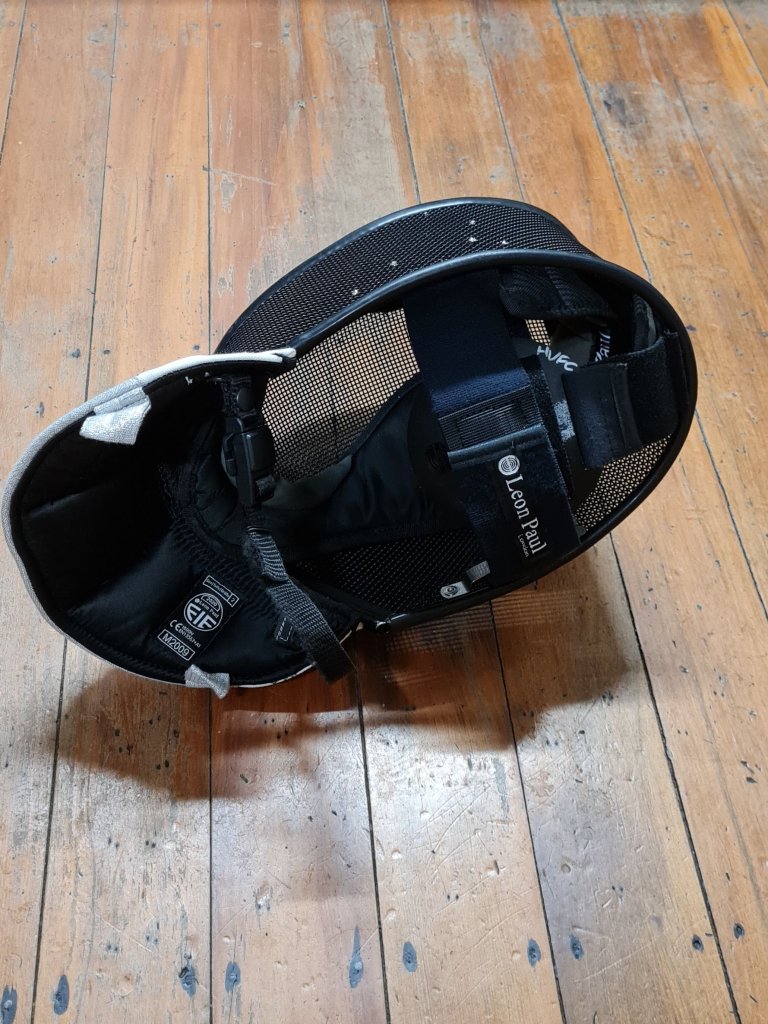
Leon Paul Dome Mask
For Leon Paul masks with a dome back, you are required to have 2 safety systems securing the mask to your head. You require both the overlapping elastic strap which has both of the same benefits as mentioned previously.
The other system that you need is a second strap that affixes to the bib of the mask. Leon Paul sell a proprietary strap with magnetic ends that allow you to easily strap up and remove with one hand.
Not a helmet. Made from a steel mesh and kevlar bib, a mask protects your face, head and neck from being hit by a fencing weapon.
There are 3 different types of masks depending on what weapon you choose to fence. There are a couple of key difference to note about these.
Foil
The foil mask has an insulated mesh with a metallic lame that covers 3/4 of the bib. This is because the neck is valid target in foil where the head up neck are not. When any part other than the lame is hit, a non-valid light will display.
Sabre
The sabre mask has an un-insulated mesh with a full lame of the bib. The entire head and neck are a valid target. The blade of the sabre is conductive so when the mask is a hit, a on target (coloured) light will register.
Epee
The epee mask is fully insulated with no lame material on it at all. The whole body is target in epee, including the feet. This means that the electronics on the weapon work different from foil or sabre. Both of these weapons work by conducting on a lame (un-insulated surface) to register a valid hit on target).
Fencing typically requires a lot of personal gear in order to keep you safe whilst you have fun. Most clubs, HVFC included, have a large selection of gear that you can borrow until you are ready to purchase your own.
Protective gear comes with different ratings, 350N or 800N. 350N is sufficient for training and most local tournaments, but 800N is usually required for national and international competitions. Fencing gear is traditionally white, though more colours are beginning to join the ranks. However, black cannot be worn by fencers, as this is reserved for coaches. For more info on safety and buying guide, click here.
This is the outer layer of protection. A jacket is made from strong materials designed to absorb the strength of a hit, and prevent sharp objects (such as broken swords) from penetrating.
Plastron
This is worn under the jacket to provide a second layer of protection on the sword-arm side of your body, where you are hit most often.
Chest Protector
This is a hard, plastic covering worn under the jacket and plastron to help reduce the impact of a hit.
Glove
This is only worn on the sword-hand, to protect your fingers and hand from fast moving weapons.
Breeches
Made of a similar material to a jacket, breeches protect your legs and waist from weapons. However, they usually stop just below the knee, so a complemented with a pair of long socks.
Lamé
This is a metallic weave vest (foil and sabre only), used to conduct a current through your opponent’s sword to determine when a point has been scored.
Body/head wire:
These are used to connect your weapon and lamé to a centralised scoring box so that the referee knows when a point has been scored.
Registration closes on October 17th at 8:00pm. Late entries close on October 20th at 8:00pm. After this date entry will be at the discretion of the DT and Referees representative. Team nominations need to be entered by 17th October, please ensure team manager contact details are supplied.
Entry Fees: (NZ Dollars)
Oceania & NZ Senior Championship: $90.00 for each weapon
National Veteran Championship: $80.00
Team Events: $150.00 per team
Late Entries, received after 8:00pm on October 17th will attract an additional fee of $50.00
Entry fees are payable via the entry system.
Multiple Discipline Entry: if you are entered in multiple weapons and your next one starts prior to completion of the first, you will be scratched from the start on the second event and are expected to continue to compete in the first event. No refund will be provided.
For Oceania and New Zealand Senior Individual and Oceania Team events
Equipment
Standard
Torso
Minimum of 1600N protection. i.e an 800N plastron and an 800N Jacket
Breeches
800N (CEN 2)
Foil Specific
FIE blades are required with 2-pin body wires. FIE no.3 size blades are acceptable.
Epee Specific
FIE blades are required. Leon Paul SR-71 blades date stamped 2013 to 2015 will not be accepted. Leon Paul V blade without a unique serial number will not be accepted.
Sabre Sepcific
FIE blades S2000 or later are required
Mask
FIE Rules apply. Min 1600N Double Strapped
Wires
FIE Rules apply – clear wires and plugs
Names do NOT need to be printed on Jackets or Lames. All equipment is to meet all other FIE rules and standards. Weapons, wires, masks, gloves, and conductive jackets (lames) will all be subject to a weapons control. Please note: at foil and sabre, clear plugs on the wires will be required and only 2-pin body wires will be allowed.
For NZ Veteran Events
quipment
Standard
Torso
Minimum of 1150N protection. i.e an 350N plastron and an 800N Jacket or the reverse.
Breeches
350N (CEN 1)
Foil Specific
FIE blades are required with either Bayonet or 2-pin body wires. FIE no.3 size blades are acceptable
Epee Specific
FIE blades are required. Leon Paul SR-71 blades date stamped 2013 to 2015 will not be accepted. Leon Paul V blade without a unique serial number will not be accepted.
Sabre Sepcific
FIE blades S2000 or later are required
Names do NOT need to be printed on Jackets or Lames.
Time Table
Saturday 22nd of October
Event
Registration Opens
Registration Closes
Start time
Men’s Foil
7:45am
8:00am
8:30am
Women’s Épée
Morning
Men’s & Women’s Sabre
Afternoon
Oceania Men’s Foil Teams
Start of Indiv. Semi Finals
Oceania Women’s Epee Teams
Start of Indiv. Semi Finals
Sunday 23rd of October
Event
Registration Opens
Registration Closes
Start time
Any Team matches not completed
Saturday will re-start at
8:30am
Men’s Épée
9:45am
10:00
10:30am
Women’s Foil
Morning
Vet Men’s & Women’s Sabre
Afternoon
Oceania Men’s Sabre Teams
Start of Indiv. Semi Finals
Oceania Women’s Sabre Teams
Start of Indiv. Semi Finals
Monday 24th of October
Event
Registration Opens
Registration Closes
Start time
Vet Men’s & Women’s Épée
8:15
8:30am
8:30am
Oceania Men’s Epee Teams
Start of Indiv. Semi Finals
8:45
Oceania Women’s Foil Teams
Start of Indiv. Semi Finals
8:45
Veteran Men’s & Womens Foil
Afternoon
*Start times will be set once entries are closed ** Team events will follow the associated individual events