
Fencing Equipment

Fencing typically requires a lot of personal gear in order to keep you safe whilst you have fun. Most clubs, HVFC included, have a large selection of gear that you can borrow until you are ready to purchase your own.

Protective gear comes with different ratings, 350N or 800N. 350N is sufficient for training and most local tournaments, but 800N is usually required for national and international competitions. Fencing gear is traditionally white, though more colours are beginning to join the ranks. However, black cannot be worn by fencers, as this is reserved for coaches.
For more info on safety and buying guide, click here.

Masks

Not a helmet. Made from a steel mesh and kevlar bib, a mask protects your face, head and neck from being…

Keep reading
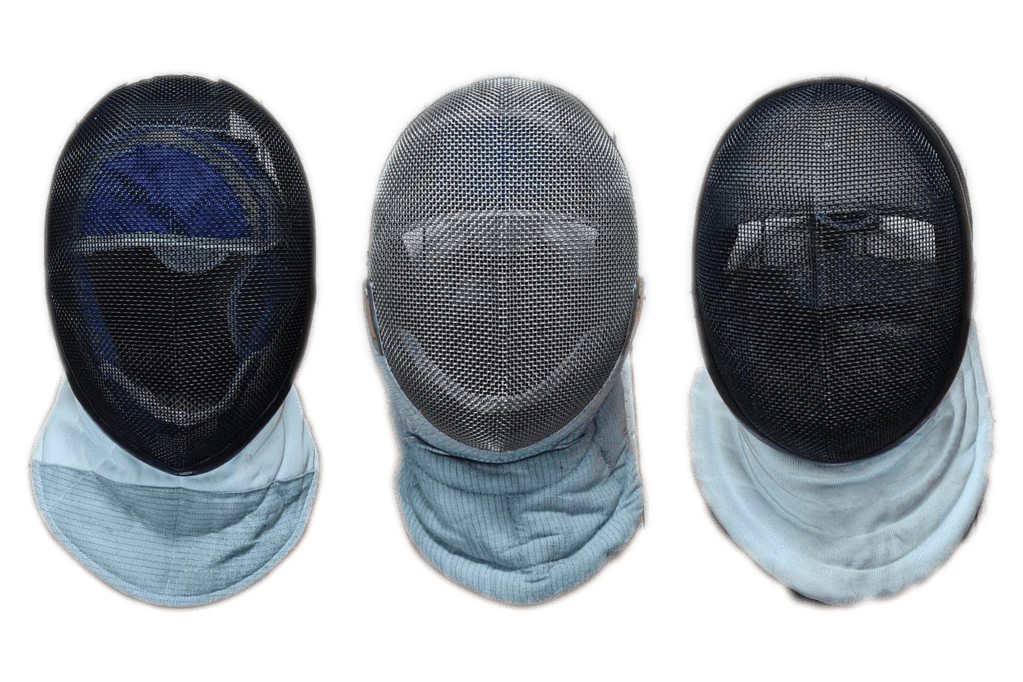
Foil, Sabre & Epee Masks

The Weapons

Last but certainly not least, is the weapon of your choice. Within each discipline, there is much choice for a…

Keep reading

Jacket

This is the outer layer of protection. A jacket is made from strong materials designed to absorb the strength of a hit, and prevent sharp objects (such as broken swords) from penetrating.

Plastron

This is worn under the jacket to provide a second layer of protection on the sword-arm side of your body, where you are hit most often.

Chest Protector

This is a hard, plastic covering worn under the jacket and plastron to help reduce the impact of a hit.

Glove

This is only worn on the sword-hand, to protect your fingers and hand from fast moving weapons.

Breeches

Made of a similar material to a jacket, breeches protect your legs and waist from weapons. However, they usually stop just below the knee, so a complemented with a pair of long socks.

Lamé

This is a metallic weave vest (foil and sabre only), used to conduct a current through your opponent’s sword to determine when a point has been scored.

Body/head wire:

These are used to connect your weapon and lamé to a centralised scoring box so that the referee knows when a point has been scored.
Fencing During the School Holidays

We will be running some sessions during the school holidays during the first week. The training times we have are.

  • Saturday 1st of October
    • 11am – 12.30pm
    • *U9s 11am – 12.00pm
  • Monday 3rd of October
    • U15/beginner class – 6.00pm – 7.00pm
    • Advanced fencers – 7.00pm – 9.00pm

We are still waiting to get confirmation for time slots in the second week of the holidays. Please stay tuned for updates moving forward.

Oceania and NZ National Seniors& Veteran Championships 2022

Registration

Registration closes on October 17th at 8:00pm. Late entries close on October 20th at 8:00pm. After this date entry will be at the discretion of the DT and Referees representative. Team nominations need to be entered by 17th October, please ensure team manager contact details are supplied.

Entry Fees: (NZ Dollars)

  • Oceania & NZ Senior Championship: $90.00 for each weapon
  • National Veteran Championship: $80.00
  • Team Events: $150.00 per team
  • Late Entries, received after 8:00pm on October 17th will attract an additional fee of $50.00
  • Entry fees are payable via the entry system.

Multiple Discipline Entry: if you are entered in multiple weapons and your next one starts prior to completion of the first, you will be scratched from the start on the second event and are expected to continue to compete in the first event. No refund will be provided.

Location

Gear Requirements

For Oceania and New Zealand Senior Individual and Oceania Team events

EquipmentStandard
TorsoMinimum of 1600N protection. i.e an 800N plastron and an 800N Jacket
Breeches800N (CEN 2)
Foil SpecificFIE blades are required with 2-pin body wires. FIE no.3 size blades are acceptable.
Epee SpecificFIE blades are required.
Leon Paul SR-71 blades date stamped 2013 to 2015 will not be accepted.
Leon Paul V blade without a unique serial number will not be accepted.
Sabre SepcificFIE blades S2000 or later are required
MaskFIE Rules apply. Min 1600N Double Strapped
WiresFIE Rules apply – clear wires and plugs
Names do NOT need to be printed on Jackets or Lames.
All equipment is to meet all other FIE rules and standards.
Weapons, wires, masks, gloves, and conductive jackets (lames) will all be
subject to a weapons control.
Please note: at foil and sabre, clear plugs on the wires will be required and
only 2-pin body wires will be allowed.

For NZ Veteran Events

quipmentStandard
TorsoMinimum of 1150N protection. i.e an 350N plastron and an 800N Jacket or the reverse.
Breeches350N (CEN 1)
Foil SpecificFIE blades are required with either Bayonet or 2-pin body wires. FIE no.3 size blades are acceptable
Epee SpecificFIE blades are required.
Leon Paul SR-71 blades date stamped 2013 to 2015 will not be accepted.
Leon Paul V blade without a unique serial number will not be accepted.
Sabre SepcificFIE blades S2000 or later are required
Names do NOT need to be printed on Jackets or Lames.

Time Table

Saturday 22nd of October

EventRegistration OpensRegistration ClosesStart time
Men’s Foil7:45am8:00am8:30am
Women’s ÉpéeMorning
Men’s & Women’s SabreAfternoon
Oceania Men’s Foil TeamsStart of Indiv. Semi Finals
Oceania Women’s Epee TeamsStart of Indiv. Semi Finals

Sunday 23rd of October

EventRegistration OpensRegistration ClosesStart time
Any Team matches not completedSaturday will re-start at8:30am
Men’s Épée9:45am10:0010:30am
Women’s FoilMorning
Vet Men’s & Women’s SabreAfternoon
Oceania Men’s Sabre TeamsStart of Indiv. Semi Finals
Oceania Women’s Sabre TeamsStart of Indiv. Semi Finals

Monday 24th of October

EventRegistration OpensRegistration ClosesStart time
Vet Men’s & Women’s Épée8:158:30am8:30am
Oceania Men’s Epee TeamsStart of Indiv. Semi Finals8:45
Oceania Women’s Foil TeamsStart of Indiv. Semi Finals8:45
Veteran Men’s & Womens FoilAfternoon


*Start times will be set once entries are closed ** Team events will follow the associated individual events

More Information

Sabre

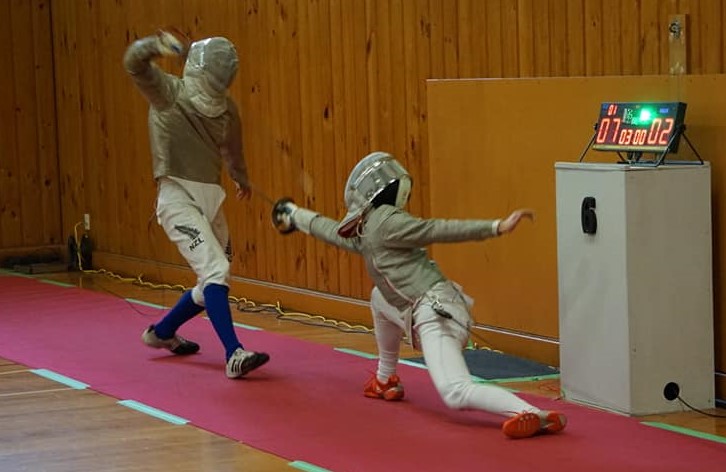
Sabre is the fastest and most aggressive of the weapons, though still requires cunning and tactics. Unlike Epée and foil, points are scored through a cutting movement on the edge of the blade, against the opponent’s upper body. The sabre is the modern version of the slashing cavalry sword. Initially heavy and curved, the present-day weapon is extremely light and straight.

To simulate a cavalry rider on a horse, the target area is the entire body above the waist, excluding the hands. Sabre bouts are often over very quickly, but similarly to foil, are also dictated by rules of priority.

Historical Context

The sabre is the modern version of the slashing cavalry sword. It was quite popular (it was very effective) and was adopted by several European armies. In fact, in the eighteenth and early nineteenth centuries, the cavalry of all nations practiced sabre fencing and fighting.

Initially heavy and curved, the present day weapon is extremely light and straight. To simulate a cavalry rider on a horse, the target area is the entire body above the waist, excluding the hands.

In addition, sabre employs rules of priority, which are very similar to foil, but with some subtle differences.  Like foil, the fencer who starts to attack first is given priority should his opponent counter-attack. However, sabre referees are much less forgiving of hesitation by an attacker. It is common to see a sabre fencer execute a stop cut against their opponent’s forearm during such a moment of hesitation, winning right-of-way and the point. Another major distinction of the sabre is that sabre fencers can score with the edge of their blade as well as their point.

The sabre fencer’s uniform features an electrically wired metallic lamé, which fully covers their valid target area. Because the head is valid target area, the fencer’s mask is also electrically wired. One significant departure from foil is that off-target hits do not register on the scoring machine, and therefore do not halt the fencing action.

If epee is the weapon of patient, defensive strategy, then sabre is its polar opposite. In sabre, the rules of right-of-way strongly favour the fencer who attacks first, and a mere graze by the blade against the lamé registers a touch. As a result, sabre is a fast, aggressive game with fencers rushing their opponent from the moment their referee gives the instruction to fence. As fending off the attack of a skilled opponent is nearly impossible, sabre fencers very rarely purposely take the defensive. However, when forced to do so, they often go all-out using spectacular tactical combinations in which victory or defeat is determined by the slightest of margins.

Epee

While a special version of the foil was developed for practice, another type of sword was created for duelling. The blade had a triangular cross-section, with slightly concave sides to reduce weight without reducing strength.  The colichemarde evolved into the modern epee. 

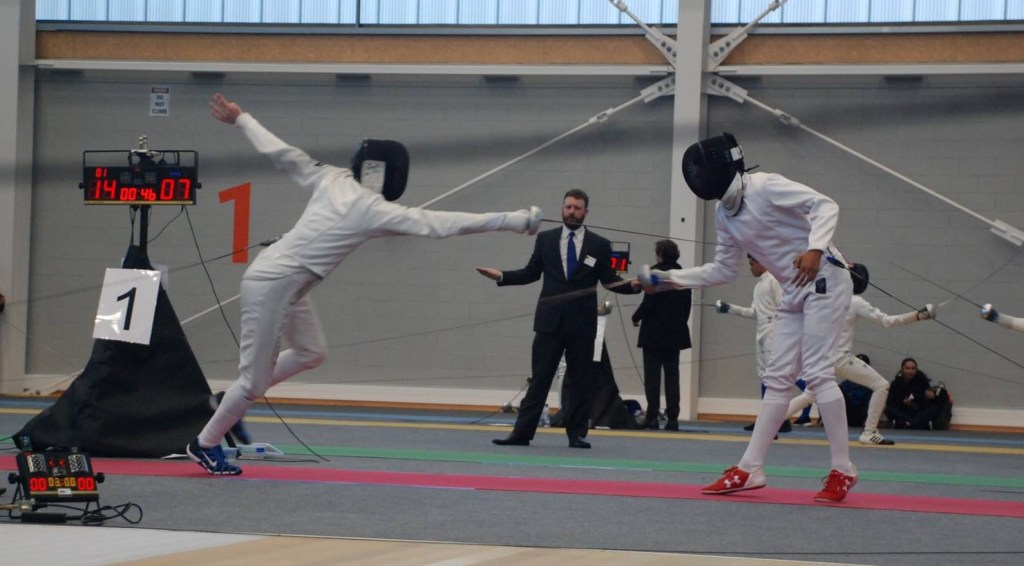
In epee the entire body is considered a valid target. Points can be scored simultaneously by both fencers, meaning timing and tactics are an essential part of an épéeist’s repertoire.

Historical Context

While a special version of the court sword, the foil, was developed for practice, another type of sword, the colichemarde, was created for duelling. The blade had a triangular cross-section, with slightly concave sides to reduce weight without reducing strength and the forte was grooved to allow the blood to drain away (and to make it easier to remove the sword from the body!).

As the epee evolved, the idea was to develop epee fencing in a manner that reproduced as closely as possible the conditions of an actual duel to first blood. As a result, in epee the entire body is considered a valid target and there is no priority rule: anything goes (almost).

Epee fencers score a point by hitting their opponent first. If the fencers hit each other within 1/25th of a second, both receive a point – this is commonly referred to as a double touch.
The lack of right-of-way combined with a full-body target naturally makes epee a game of careful strategy and patience – wild, rash attacks are quickly punished with solid counter-attacks. So, rather than attacking outright, epeeists often spend several minutes probing their opponent’s defences and manoeuvring for distance before risking an attack. Others may choose to stay on the defensive throughout the entire bout. As an epee watcher you also need to have patience.